%20--%3e%3csvg%20version='1.1'%20id='Ebene_1'%20xmlns='http://www.w3.org/2000/svg'%20xmlns:xlink='http://www.w3.org/1999/xlink'%20x='0px'%20y='0px'%20viewBox='0%200%20897.61%20762.46'%20style='enable-background:new%200%200%20897.61%20762.46;'%20xml:space='preserve'%3e%3cstyle%20type='text/css'%3e%20.st0{fill:%2305171D;}%20%3c/style%3e%3cg%3e%3cpath%20class='st0'%20d='M211.66,376.86h-2.38c-7.13,27.08-34.67,47.52-66.99,47.52c-63.19,0-95.97-46.1-95.97-130.67%20c0-84.58,32.78-130.19,95.97-130.19c32.32,0,59.86,19.96,66.99,47.51h2.38V67.07h70.32v351.61h-70.32V376.86z%20M211.66,330.78%20v-73.64c0-22.81-19.48-36.59-46.09-36.59s-46.09,20.43-46.09,51.8v43.24c0,31.36,19.48,51.79,46.09,51.79%20S211.66,353.58,211.66,330.78'/%3e%3cpath%20class='st0'%20d='M352.28,223.87h-35.16v-54.64h35.16v-29.46c0-48,26.13-72.7,74.6-72.7h45.61v54.65h-49.9v47.51h49.9v54.64%20h-49.9v194.81h-70.32V223.87z'/%3e%3cpolygon%20class='st0'%20points='503.46,67.07%20573.78,67.07%20573.78,274.71%20576.63,274.71%20607.53,228.62%20657.41,169.23%20735.33,169.23%20652.19,264.73%20744.83,418.67%20661.21,418.67%20605.14,313.2%20573.78,348.36%20573.78,418.67%20503.46,418.67%20'/%3e%3crect%20x='773.37'%20y='169.22'%20class='st0'%20width='70.32'%20height='249.45'/%3e%3cpath%20class='st0'%20d='M808.53,52.95c20.96,0,38.01,17.05,38.01,38.01c0,20.96-17.05,38.01-38.01,38.01%20c-20.95,0-38.01-17.05-38.01-38.01C770.52,70,787.58,52.95,808.53,52.95%20M808.53,48.2c-23.61,0-42.76,19.15-42.76,42.76%20c0,23.61,19.15,42.76,42.76,42.76c23.61,0,42.76-19.15,42.76-42.76C851.29,67.35,832.14,48.2,808.53,48.2'/%3e%3cpath%20class='st0'%20d='M838.94,703.81h-60.82V463.87h60.82V703.81z%20M843.69,459.11h-70.32v249.45h70.32V459.11z'/%3e%3cg%3e%3cpath%20class='st0'%20d='M712.05,653.92V544.64c0-58.92-36.11-91.22-106.44-91.22c-52.26,0-80.77,18.05-100.72,47.51l41.81,37.06%20c10.93-15.2,25.66-29.46,53.69-29.46c29.46,0,41.33,15.2,41.33,39.43v15.68h-39.42c-66.06,0-106.91,25.19-106.91,77.93%20c0,43.24,27.56,72.69,77.44,72.69c35.05,0,63.89-13.96,74.36-39.92h2.38c6.68,21,22.97,34.22,44.93,34.22h40.83v-54.64H712.05z%20M730.58,703.81H694.5c-20.72,0-36.15-13.03-41.53-34.22h-1.73h-1.27h-0.82h-3.21h-1.77c-8.71,25.38-36.29,39.92-71.34,39.92%20c-45.52,0-72.69-25.39-72.69-67.94c0-60.48,55.55-73.18,102.16-73.18h39.42h4.75v-4.75v-15.68c0-28.91-15.94-44.19-46.09-44.19%20c-28.04,0-43.84,13.77-54.39,27.23l-34.78-30.83c21.11-29.03,50.43-42.02,94.4-42.02c66.53,0,101.69,29.9,101.69,86.47v109.29%20v4.75h4.75h18.53V703.81z'/%3e%3cpath%20class='st0'%20d='M646.47,603.56v-4.75h-4.75h-34.21c-40.1,0-46.09,20.54-46.09,32.78v7.13c0,11.71,4.87,31.36,37.53,31.36%20c29.3,0,47.51-14.21,47.51-37.06V603.56z%20M641.72,633.02c0,22.81-19.48,32.31-42.76,32.31c-20.9,0-32.78-8.55-32.78-26.61v-7.13%20c0-18.05,14.25-28.03,41.34-28.03h34.21V633.02z'/%3e%3c/g%3e%3c/g%3e%3c/svg%3e)
Expertise · Biomedical Signal Processing
Biomedical Signal Processing
AI-powered biomedical signal processing for wearable devices, physiological monitoring and next-generation medical technologies.
Modern healthcare increasingly depends on extracting meaningful information from physiological signals. DFKI develops advanced AI and signal processing methods that transform complex biomedical data into robust, explainable and clinically useful insights.
Discuss Your Project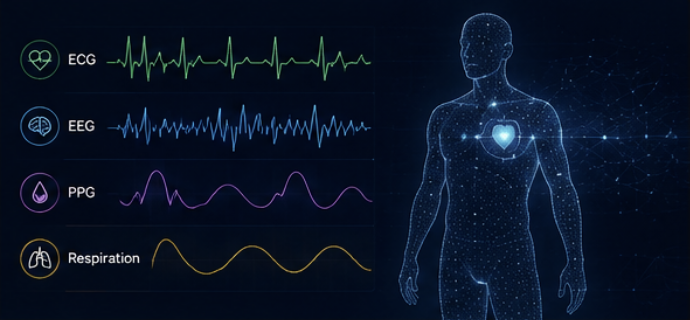
Industry Challenges
Challenges in Biomedical Signal Processing
Physiological data is noisy, sparsely labelled and captured under real-world conditions. These are the recurring obstacles our research addresses with industry partners.
Noisy physiological signals
Motion artefacts, electrode drift and ambient interference distort ECG, EEG and PPG recordings. Robust denoising and artefact handling are prerequisites for any reliable analysis.
Limited annotated medical datasets
Clinical labelling is expensive and scarce. Self-supervised, weakly-supervised and transfer learning methods are needed to learn from small annotated cohorts.
Multimodal sensor integration
Signals arrive at different sampling rates, resolutions and quality levels. Fusing them into one coherent representation is a core engineering and modelling challenge.
Real-time processing requirements
Monitoring and alerting systems must react within seconds. Models have to meet strict latency budgets without sacrificing diagnostic reliability.
Explainable AI for healthcare
Clinicians and regulators need to understand why a model raised a flag. Interpretability must be designed in, not added afterwards.
Deployment on edge devices
Wearables and medical devices operate under tight power, memory and connectivity constraints. Models need compression and hardware-aware optimisation.
Our Expertise
Our Expertise
From signal conditioning to foundation models, DFKI covers the full methodological stack behind physiological signal processing and biomedical signal analysis.
Biomedical Signal Processing
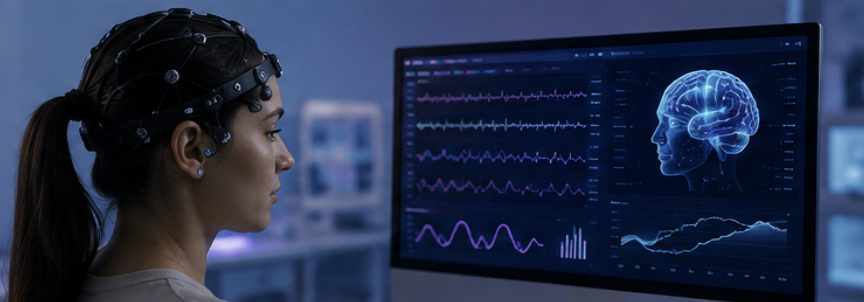
Classical and learned filtering, artefact removal and signal quality assessment that turn raw sensor streams into analysis-ready data.
AI-based Feature Extraction
Automatically derived, clinically meaningful features that outperform hand-crafted markers and shorten development cycles.
Deep Learning for Time Series
Sequence models, temporal convolutions and transformers designed for long, continuous physiological recordings.
Physiological Signal Analysis
Event detection, rhythm classification and anomaly analysis validated against clinical reference standards.
Multimodal Sensor Fusion
Combining ECG, PPG, respiration, motion and contextual data into unified models with higher accuracy and robustness.
Explainable AI
Attribution, uncertainty estimation and transparent decision paths that support clinical trust and regulatory documentation.
Edge AI
Quantised, pruned and hardware-aware models that run on-device in wearables and embedded medical technology.
Foundation Models
Pre-trained biosignal representations that transfer to new tasks and devices with far fewer annotated examples.
Typical Applications
Typical Applications
AI for biomedical signal processing applies across clinical monitoring, wearable technology and biomedical engineering programmes.
ECG Analysis
Arrhythmia detection, rhythm classification and continuous cardiac risk assessment.
EEG Analysis
Sleep staging, seizure detection and neurological state monitoring from brain activity.
EMG Analysis
Muscle activation, fatigue and movement intent for rehabilitation and prosthetics.
PPG Analysis
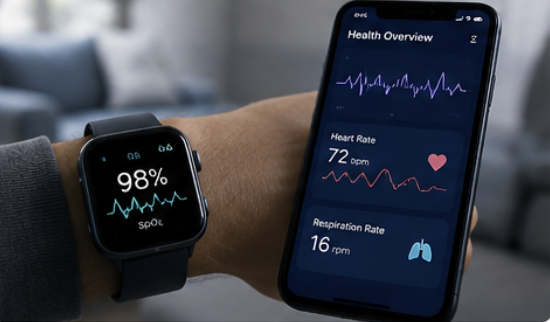
Heart rate, variability and perfusion metrics from optical wearable sensors.
Respiratory Monitoring
Breathing rate, effort and apnoea detection from contact and contactless sensing.
Wearable Health Devices
On-device intelligence for consumer and medical-grade wearable technology.
Remote Patient Monitoring
Continuous out-of-hospital monitoring with early-warning and escalation logic.
Clinical Decision Support
Signal-derived insights integrated into clinical workflows and documentation.
Why DFKI
Why Partner with DFKI
An independent, non-profit research partner combining scientific depth with a proven route from prototype to product.
Applied AI Research
Methods developed and validated in one of Europe's largest applied AI research centers — publication-grade science aimed at real deployment.
Industry Collaboration
Long-standing joint projects with MedTech, wearable and healthcare partners across Europe and internationally.
Rapid AI Prototyping
Feasibility studies and working prototypes that answer the value question early, on your data and in your context.
Technology Transfer
A structured path from research result to integration-ready components inside your product or clinical system.
Collaboration Process
From industry challenge to technology transfer.
A structured, evidence-driven path that de-risks each stage before the next investment.
Step 1
Industry Challenge
Define the clinical or product problem and success criteria.
Step 2
Available Data
Assess signal sources, quality, annotations and gaps.
Step 3
Feasibility Study
Test whether the AI approach can deliver measurable value.
Step 4
AI Prototype
Build a working model and pipeline on your real data.
Step 5
Validation
Benchmark against clinical references and evaluation criteria.
Step 6
Technology Transfer
Hand over integration-ready methods and know-how.
Related Expertise & Services
Where biomedical signal processing connects.
Biosignal research pairs naturally with explainable AI, physics-informed modelling and MedTech product development.
Medical AI R&D Partner
Research-to-prototype collaboration across imaging, sensing and movement analysis.
Learn morePhysics-Informed AI
Combining scientific models and AI for simulation, sensing and optimisation.
Learn moreExplainable Medical AI
Interpretable AI methods supporting clinical trust, validation and regulatory review.
Learn moreAI for Medical Device Companies
Applied AI R&D for MedTech, sensors and wearable technology.
Learn moreSignal processing is one step on the path from sensing to AI — read our guide to medical device development.
Let's Build Your Next Medical AI Solution
Whether you are developing wearable technologies, medical devices or AI-driven healthcare solutions, DFKI helps transform biomedical signals into valuable clinical insights.