%20--%3e%3csvg%20version='1.1'%20id='Ebene_1'%20xmlns='http://www.w3.org/2000/svg'%20xmlns:xlink='http://www.w3.org/1999/xlink'%20x='0px'%20y='0px'%20viewBox='0%200%20897.61%20762.46'%20style='enable-background:new%200%200%20897.61%20762.46;'%20xml:space='preserve'%3e%3cstyle%20type='text/css'%3e%20.st0{fill:%2305171D;}%20%3c/style%3e%3cg%3e%3cpath%20class='st0'%20d='M211.66,376.86h-2.38c-7.13,27.08-34.67,47.52-66.99,47.52c-63.19,0-95.97-46.1-95.97-130.67%20c0-84.58,32.78-130.19,95.97-130.19c32.32,0,59.86,19.96,66.99,47.51h2.38V67.07h70.32v351.61h-70.32V376.86z%20M211.66,330.78%20v-73.64c0-22.81-19.48-36.59-46.09-36.59s-46.09,20.43-46.09,51.8v43.24c0,31.36,19.48,51.79,46.09,51.79%20S211.66,353.58,211.66,330.78'/%3e%3cpath%20class='st0'%20d='M352.28,223.87h-35.16v-54.64h35.16v-29.46c0-48,26.13-72.7,74.6-72.7h45.61v54.65h-49.9v47.51h49.9v54.64%20h-49.9v194.81h-70.32V223.87z'/%3e%3cpolygon%20class='st0'%20points='503.46,67.07%20573.78,67.07%20573.78,274.71%20576.63,274.71%20607.53,228.62%20657.41,169.23%20735.33,169.23%20652.19,264.73%20744.83,418.67%20661.21,418.67%20605.14,313.2%20573.78,348.36%20573.78,418.67%20503.46,418.67%20'/%3e%3crect%20x='773.37'%20y='169.22'%20class='st0'%20width='70.32'%20height='249.45'/%3e%3cpath%20class='st0'%20d='M808.53,52.95c20.96,0,38.01,17.05,38.01,38.01c0,20.96-17.05,38.01-38.01,38.01%20c-20.95,0-38.01-17.05-38.01-38.01C770.52,70,787.58,52.95,808.53,52.95%20M808.53,48.2c-23.61,0-42.76,19.15-42.76,42.76%20c0,23.61,19.15,42.76,42.76,42.76c23.61,0,42.76-19.15,42.76-42.76C851.29,67.35,832.14,48.2,808.53,48.2'/%3e%3cpath%20class='st0'%20d='M838.94,703.81h-60.82V463.87h60.82V703.81z%20M843.69,459.11h-70.32v249.45h70.32V459.11z'/%3e%3cg%3e%3cpath%20class='st0'%20d='M712.05,653.92V544.64c0-58.92-36.11-91.22-106.44-91.22c-52.26,0-80.77,18.05-100.72,47.51l41.81,37.06%20c10.93-15.2,25.66-29.46,53.69-29.46c29.46,0,41.33,15.2,41.33,39.43v15.68h-39.42c-66.06,0-106.91,25.19-106.91,77.93%20c0,43.24,27.56,72.69,77.44,72.69c35.05,0,63.89-13.96,74.36-39.92h2.38c6.68,21,22.97,34.22,44.93,34.22h40.83v-54.64H712.05z%20M730.58,703.81H694.5c-20.72,0-36.15-13.03-41.53-34.22h-1.73h-1.27h-0.82h-3.21h-1.77c-8.71,25.38-36.29,39.92-71.34,39.92%20c-45.52,0-72.69-25.39-72.69-67.94c0-60.48,55.55-73.18,102.16-73.18h39.42h4.75v-4.75v-15.68c0-28.91-15.94-44.19-46.09-44.19%20c-28.04,0-43.84,13.77-54.39,27.23l-34.78-30.83c21.11-29.03,50.43-42.02,94.4-42.02c66.53,0,101.69,29.9,101.69,86.47v109.29%20v4.75h4.75h18.53V703.81z'/%3e%3cpath%20class='st0'%20d='M646.47,603.56v-4.75h-4.75h-34.21c-40.1,0-46.09,20.54-46.09,32.78v7.13c0,11.71,4.87,31.36,37.53,31.36%20c29.3,0,47.51-14.21,47.51-37.06V603.56z%20M641.72,633.02c0,22.81-19.48,32.31-42.76,32.31c-20.9,0-32.78-8.55-32.78-26.61v-7.13%20c0-18.05,14.25-28.03,41.34-28.03h34.21V633.02z'/%3e%3c/g%3e%3c/g%3e%3c/svg%3e)
Resources · Pillar Guide
Medical Device Development:
From Research to AI-Enabled Prototype
Developing a new medical device increasingly requires more than hardware or software alone.
Modern medical technologies combine sensing, physiological data, signal processing, medical imaging, machine learning and clinical requirements into a single system.
DFKI helps healthcare and MedTech organisations investigate whether ambitious technology concepts are technically feasible — and turn promising ideas into validated prototypes and research demonstrators.
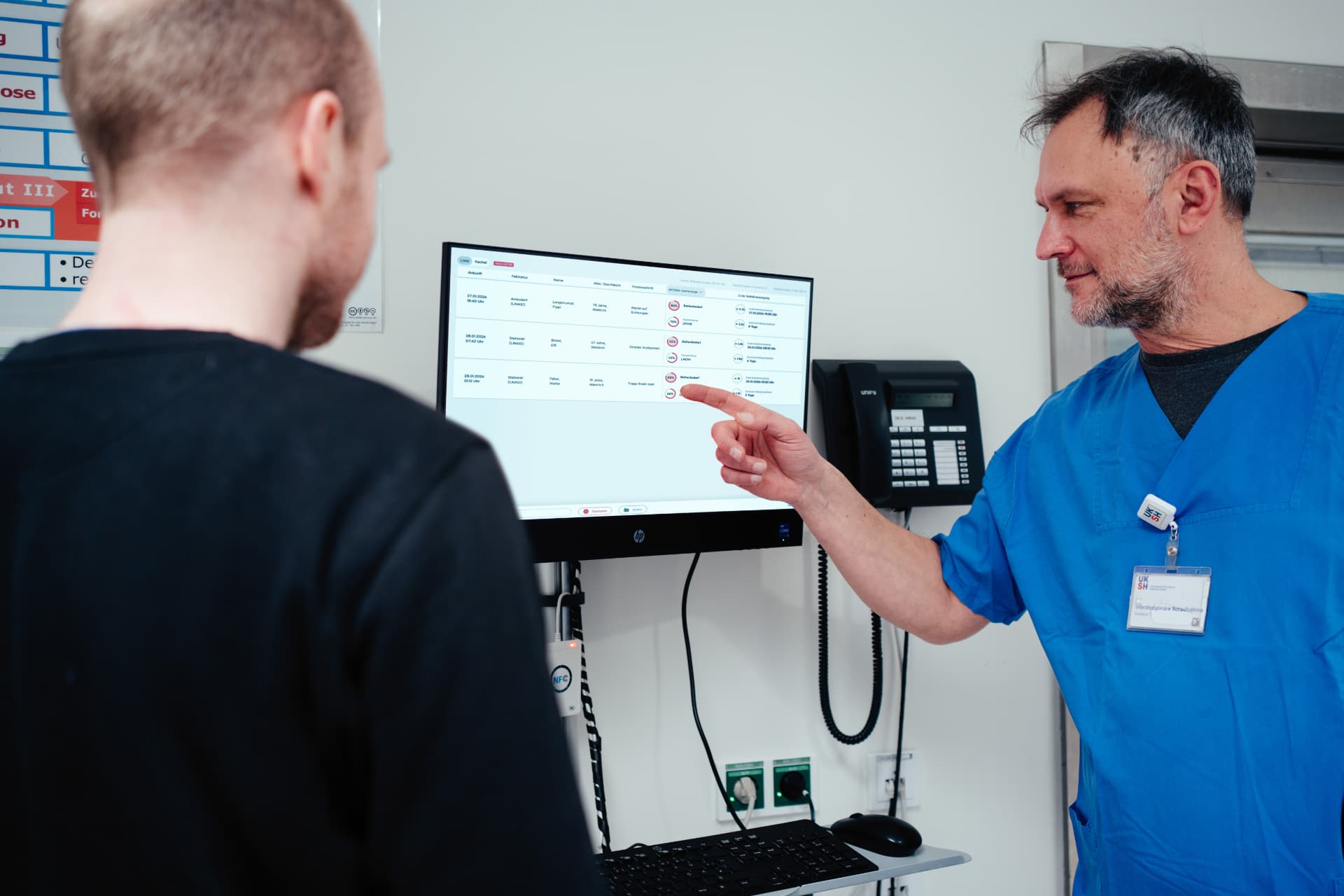
From Idea to Working Technology
The Difficult Part Is Connecting the Pieces
A medical technology concept may begin with a clinical problem, a new sensor, an imaging modality, an existing dataset or an idea for using AI.
The challenge is turning those individual components into a system that actually works.
This is where applied research becomes particularly valuable.
Before committing to full-scale product development, organisations can investigate critical technical questions, test alternative approaches and validate the core technology through focused R&D.
- 01Clinical Need
- 02Sensors / Imaging / Data
- 03Signal & Image Processing
- 04AI / Machine Learning
- 05Prototype
- 06Technical Validation
- 07Clinical Development
R&D Path
A Research-Driven Medical Device Development Process
01
Define the Clinical and Technical Problem
Clarify what the device should measure, detect, predict or support and identify the technical uncertainties that must be solved.
02
Feasibility Study
Evaluate available sensors, data, algorithms, imaging technologies and system architecture.
Key question: Can the idea work technically?
03
Data, Sensors & Signal Processing
Develop the data acquisition and processing pipeline.
- Physiological signals
- Wearable sensors
- Imaging data
- Multimodal data
- Biosignals
- Sensor fusion
04
AI & Algorithm Development
Investigate suitable machine learning, deep learning or analytical approaches.
- Classification
- Detection
- Segmentation
- Prediction
- Anomaly detection
- Temporal modelling
- Multimodal AI
05
Prototype / Proof of Concept
Integrate the relevant hardware, data processing and AI components into a working research prototype.
06
Technical Validation
Evaluate performance, robustness and limitations before proceeding toward larger clinical or commercial development.
The exact development path depends on the technology, clinical application, available data and maturity of the concept.
You Don't Need to Start With a Finished Product Specification
R&D projects often begin much earlier.
A Clinical Problem
“We believe technology could solve this problem, but we don't yet know how.”
A Sensor or Hardware Concept
“We can measure something interesting, but need to understand how to turn the signal into clinically useful information.”
Existing Data
“We have valuable clinical or physiological data and want to investigate what AI could extract from it.”
An AI Concept
“We have an AI use case but need to determine the right data, architecture and validation approach.”
An Existing Medical Device
“We want to add sensing, intelligence or AI capabilities to an existing product.”
A Research Question
“We need to establish technical feasibility before committing to product development.”
Healthcare AI R&D
Research Expertise Across the Medical AI Technology Stack
DFKI's healthcare AI research spans the complete chain from physical sensing and medical data to advanced AI methods — from sensing to AI.
This allows research questions to be approached as complete systems rather than isolated algorithms.
Layer 1 · Medical Technology
Layer 2 · Data & Signals
- Medical Signal Processing
- Medical Image Processing
- Sensor Fusion
- Physiological Data
- Multimodal Data
Layer 3 · Artificial Intelligence
- Machine Learning
- Deep Learning
- Computer Vision
- Temporal AI
- Multimodal AI
Layer 4 · Applications
- Clinical Decision Support
- Diagnostics
- Patient Monitoring
- Digital Biomarkers
- Therapy Monitoring
- AI-Enabled Medical Devices
Questions We Can Investigate Together
- Q01Can a wearable sensor reliably capture the physiological signal we need?
- Q02Can AI identify clinically meaningful patterns in the signal?
- Q03Can multiple sensors or data modalities improve prediction accuracy?
- Q04Can medical images be analysed automatically?
- Q05Can longitudinal imaging quantify disease progression or treatment response?
- Q06Can an existing medical device be enhanced with AI?
- Q07Can we detect deterioration before conventional clinical indicators?
- Q08Can a research algorithm operate reliably with real-world patient data?
- Q09Can a technical concept be demonstrated before committing to full product development?
Medical Device Development Across Multiple Technology Areas
Medical Imaging AI
Image analysis, segmentation, registration and temporal analysis.
Explore expertiseWearable & Sensor Systems
Continuous physiological monitoring and intelligent sensing.
Explore expertiseMedical Signal Processing
Extract clinically relevant information from complex physiological signals.
Explore expertiseRemote Patient Monitoring
Combine connected devices, data processing and AI for continuous monitoring.
Explore expertiseMultimodal Healthcare AI
Combine imaging, sensor, clinical and other data sources.
Explore expertiseClinical AI
Develop and investigate AI methods for real-world healthcare applications.
Explore expertiseReduce Technical Uncertainty Before Scaling Development
One of the most expensive mistakes in medical technology development is committing too early to a specific technical architecture.
Applied R&D can answer fundamental questions before significant resources are committed to engineering, clinical development and regulatory activities.
Test Feasibility
Determine whether the underlying technical concept works.
Compare Approaches
Evaluate alternative sensors, algorithms or system architectures.
Build Evidence
Generate technical results that support the next development decision.
Applied Research
From Research Questions to Working Technology
DFKI × Xenoma
AI Wearable Technology
- Challenge
- Analysing human movement continuously and outside the lab.
- Research approach
- Intelligent wearable sensor technology with real-time movement analysis.
- Technology
- Smart textiles, wearable sensors, machine learning
- Research result
- Research on real-time human motion analysis relevant to rehabilitation and digital health.
DFKI × Hitachi
AI for Occupational Health
- Challenge
- Quantifying physical workload and ergonomic risk.
- Research approach
- AI-powered wearable sensing to measure workload and human movement.
- Technology
- Wearable sensing, activity recognition, AI
- Research result
- Applied research towards improved occupational health and safety.
DFKI × Hitachi × Xenoma
Intelligent Sensor Suit
- Challenge
- Recognising human activity in real time from the body.
- Research approach
- Combining AI, wearable sensing and smart textiles in one system.
- Technology
- Sensor suit, sensor fusion, human activity recognition
- Research result
- A research collaboration demonstrating real-time movement analysis.
When DFKI Can Be the Right R&D Partner
This page is particularly relevant for:
- MedTech companies developing new products
- Medical device manufacturers adding AI capabilities
- Healthcare technology companies working with sensors or physiological data
- Imaging technology companies
- Digital health companies moving toward physical medical technology
- Pharmaceutical and life-science organisations developing monitoring technologies
- Corporate R&D and innovation teams investigating new healthcare technologies
Typical project stages
- Idea
- Feasibility
- Research
- Proof of Concept
- Prototype
- Validation
DFKI is especially valuable in the early stages, while important technical questions are still unresolved.
Discuss Your R&D Challenge
Have a Medical Device Idea or Technical Challenge?
You don't need a finished specification.
If you are exploring a new medical device, sensing technology, healthcare AI application or intelligent monitoring system, we can start by understanding the technical question you are trying to solve.
A first conversation can focus simply on the technology, available data and the key feasibility questions.