%20--%3e%3csvg%20version='1.1'%20id='Ebene_1'%20xmlns='http://www.w3.org/2000/svg'%20xmlns:xlink='http://www.w3.org/1999/xlink'%20x='0px'%20y='0px'%20viewBox='0%200%20897.61%20762.46'%20style='enable-background:new%200%200%20897.61%20762.46;'%20xml:space='preserve'%3e%3cstyle%20type='text/css'%3e%20.st0{fill:%2305171D;}%20%3c/style%3e%3cg%3e%3cpath%20class='st0'%20d='M211.66,376.86h-2.38c-7.13,27.08-34.67,47.52-66.99,47.52c-63.19,0-95.97-46.1-95.97-130.67%20c0-84.58,32.78-130.19,95.97-130.19c32.32,0,59.86,19.96,66.99,47.51h2.38V67.07h70.32v351.61h-70.32V376.86z%20M211.66,330.78%20v-73.64c0-22.81-19.48-36.59-46.09-36.59s-46.09,20.43-46.09,51.8v43.24c0,31.36,19.48,51.79,46.09,51.79%20S211.66,353.58,211.66,330.78'/%3e%3cpath%20class='st0'%20d='M352.28,223.87h-35.16v-54.64h35.16v-29.46c0-48,26.13-72.7,74.6-72.7h45.61v54.65h-49.9v47.51h49.9v54.64%20h-49.9v194.81h-70.32V223.87z'/%3e%3cpolygon%20class='st0'%20points='503.46,67.07%20573.78,67.07%20573.78,274.71%20576.63,274.71%20607.53,228.62%20657.41,169.23%20735.33,169.23%20652.19,264.73%20744.83,418.67%20661.21,418.67%20605.14,313.2%20573.78,348.36%20573.78,418.67%20503.46,418.67%20'/%3e%3crect%20x='773.37'%20y='169.22'%20class='st0'%20width='70.32'%20height='249.45'/%3e%3cpath%20class='st0'%20d='M808.53,52.95c20.96,0,38.01,17.05,38.01,38.01c0,20.96-17.05,38.01-38.01,38.01%20c-20.95,0-38.01-17.05-38.01-38.01C770.52,70,787.58,52.95,808.53,52.95%20M808.53,48.2c-23.61,0-42.76,19.15-42.76,42.76%20c0,23.61,19.15,42.76,42.76,42.76c23.61,0,42.76-19.15,42.76-42.76C851.29,67.35,832.14,48.2,808.53,48.2'/%3e%3cpath%20class='st0'%20d='M838.94,703.81h-60.82V463.87h60.82V703.81z%20M843.69,459.11h-70.32v249.45h70.32V459.11z'/%3e%3cg%3e%3cpath%20class='st0'%20d='M712.05,653.92V544.64c0-58.92-36.11-91.22-106.44-91.22c-52.26,0-80.77,18.05-100.72,47.51l41.81,37.06%20c10.93-15.2,25.66-29.46,53.69-29.46c29.46,0,41.33,15.2,41.33,39.43v15.68h-39.42c-66.06,0-106.91,25.19-106.91,77.93%20c0,43.24,27.56,72.69,77.44,72.69c35.05,0,63.89-13.96,74.36-39.92h2.38c6.68,21,22.97,34.22,44.93,34.22h40.83v-54.64H712.05z%20M730.58,703.81H694.5c-20.72,0-36.15-13.03-41.53-34.22h-1.73h-1.27h-0.82h-3.21h-1.77c-8.71,25.38-36.29,39.92-71.34,39.92%20c-45.52,0-72.69-25.39-72.69-67.94c0-60.48,55.55-73.18,102.16-73.18h39.42h4.75v-4.75v-15.68c0-28.91-15.94-44.19-46.09-44.19%20c-28.04,0-43.84,13.77-54.39,27.23l-34.78-30.83c21.11-29.03,50.43-42.02,94.4-42.02c66.53,0,101.69,29.9,101.69,86.47v109.29%20v4.75h4.75h18.53V703.81z'/%3e%3cpath%20class='st0'%20d='M646.47,603.56v-4.75h-4.75h-34.21c-40.1,0-46.09,20.54-46.09,32.78v7.13c0,11.71,4.87,31.36,37.53,31.36%20c29.3,0,47.51-14.21,47.51-37.06V603.56z%20M641.72,633.02c0,22.81-19.48,32.31-42.76,32.31c-20.9,0-32.78-8.55-32.78-26.61v-7.13%20c0-18.05,14.25-28.03,41.34-28.03h34.21V633.02z'/%3e%3c/g%3e%3c/g%3e%3c/svg%3e)
Expertise · Medical Sensor Fusion
Medical Sensor Fusion
AI-powered fusion of multimodal medical sensor data for next-generation medical devices, wearable technologies and clinical decision support.
Modern healthcare solutions increasingly rely on combining information from multiple sensors rather than analysing individual signals in isolation. DFKI develops AI methods that integrate heterogeneous medical data into robust, explainable and clinically meaningful insights.
Discuss Your Project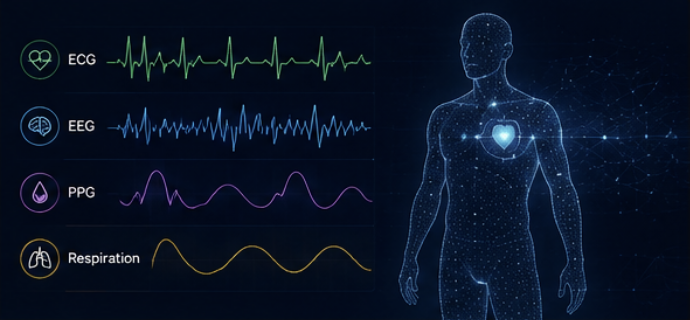
Industry Challenges
Challenges in Medical Sensor Fusion
Combining medical data sources is rarely a data-engineering detail — it decides whether a device or platform performs reliably in the field.
Heterogeneous sensor data
Medical systems combine data from multiple devices, sensors and formats — each with its own resolution, protocol and semantics.
Missing and noisy measurements
Real-world physiological data often contains artefacts, missing values and inconsistent quality across channels and sessions.
Temporal synchronisation
Accurate alignment of multimodal signals across clocks, sampling rates and devices is essential for reliable AI models.
Explainability
Medical AI requires transparent and clinically interpretable decision making — including which modality drove a given output.
Edge AI deployment
Many applications require efficient fusion models running directly on wearable or embedded medical devices.
Regulatory requirements
Healthcare AI must satisfy demanding quality, safety and privacy expectations across the full data and model lifecycle.
Our Expertise
Our Expertise
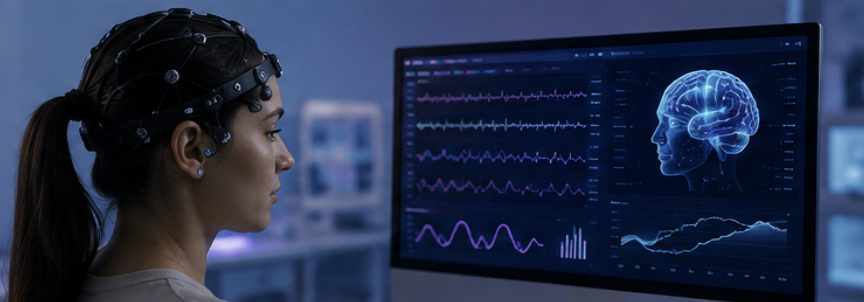
From physiological data integration to multimodal foundation models, DFKI covers the full methodological stack behind medical sensor fusion.
Medical Sensor Fusion
Architectures that merge complementary sensor streams into one decision layer, raising robustness where single-sensor models fail.
Multimodal AI
Joint representation learning across signals, images, device logs and clinical context to unlock information no single source holds.
Biomedical Signal Processing
Filtering, artefact handling and signal-quality scoring that make heterogeneous inputs safe to fuse in a product setting.
Physiological Data Integration
Synchronisation, resampling and missing-data strategies that turn fragmented device data into a consistent modelling substrate.
Time-Series Deep Learning
Sequence models and transformers built for long, continuous multi-channel recordings from real deployments.
Explainable AI
Modality attribution, uncertainty estimation and audit-ready reasoning that support clinical trust and regulatory documentation.
Edge AI
Quantised, hardware-aware fusion models that meet the power, memory and latency budgets of embedded medical technology.
Foundation Models
Pre-trained multimodal representations that transfer to new devices and indications with far fewer annotated examples.
Typical Applications
Typical Applications
Sensor fusion turns fragmented multimodal medical data into AI systems that stay dependable across patients, devices and everyday conditions.
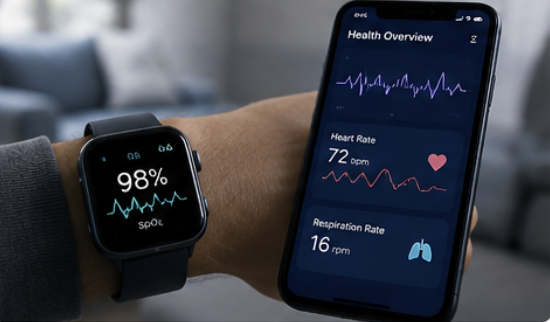
Wearable Medical Devices
Fusing optical, motion and electrical sensing on-device for measurements that stay reliable outside laboratory conditions.
Remote Patient Monitoring
Combining home devices, wearables and self-reported context into early-warning signals with fewer false alarms.
Digital Biomarkers
Cross-modal endpoints derived from continuous data, developed and validated for clinical and trial use.
Clinical Decision Support
Sensor evidence merged with clinical records so recommendations reflect the full patient picture, not one channel.
Human Movement Analysis
IMU, pressure and video fusion for accurate gait, posture and activity assessment in ambulatory settings.
Smart Rehabilitation
Multimodal feedback systems that quantify exercise quality and adapt therapy programmes to measured progress.
Connected Medical Devices
Fusion layers across device fleets and hospital systems, giving interoperable products a shared intelligence layer.
Physiological Monitoring
Continuous cardiac, respiratory and neurological monitoring where fused signals compensate for individual sensor dropouts.
Why DFKI
Why Partner with DFKI
An independent, non-profit research partner combining scientific depth with a proven route from prototype to product.
Applied AI Research
Fusion methods developed and validated in one of Europe's largest applied AI research centers — scientific rigour aimed at real deployment.
Industrial Collaboration
Long-standing joint R&D with MedTech, wearable and digital health companies across Europe and internationally.
Rapid AI Prototyping
Feasibility studies and working multimodal prototypes that answer the value question early, on your own sensor data.
Technology Transfer
A structured path from research result to integration-ready fusion components inside your product or clinical system.
Collaboration Process
From Data to AI Solution
A structured, evidence-driven path that de-risks each stage before the next investment.
Step 1
Industry Challenge
Define the product or clinical problem and the success criteria.
Step 2
Available Sensor Data
Audit sensor sources, synchronisation, quality and annotation gaps.
Step 3
Sensor Fusion & AI
Design and train multimodal models on your integrated data.
Step 4
Prototype Development
Build a working pipeline, on-device or in the cloud.
Step 5
Validation
Benchmark against clinical references and evaluation criteria.
Step 6
Technology Transfer
Hand over integration-ready methods, models and know-how.
Related Expertise & Services
Where medical sensor fusion connects.
Fusion research pairs naturally with signal analysis, explainable AI and MedTech product development.
Medical AI R&D Partner
Research-to-prototype collaboration across imaging, sensing and movement analysis.
Learn moreBiomedical Signal Processing
AI methods for analysing individual physiological signals such as ECG, EEG and PPG.
Learn moreExplainable Medical AI
Interpretable AI methods supporting clinical trust, validation and regulatory review.
Learn moreAI for Medical Device Companies
Applied AI R&D for MedTech, sensors and connected medical technology.
Learn moreCombining sensors is often where a device concept becomes feasible — explore our perspective on medical technology R&D.
Let's Build Intelligent Medical Sensor Fusion Solutions
Whether you are developing wearable medical devices, digital health platforms or AI-powered healthcare technologies, DFKI helps transform heterogeneous sensor data into clinically valuable insights.