Resources · Guides

You Don’t Need an Engineering Department to Develop an AI-Powered Medical Device

How companies can transform a healthcare innovation idea into a technically validated AI prototype without first building a large internal engineering organisation.

Many organisations have promising ideas for wearable medical devices, smart monitoring systems or AI-enabled healthcare technologies. The challenge is not the idea — it is assembling expertise in electronics, sensors, embedded systems, AI and validation.

Today, there is another approach.

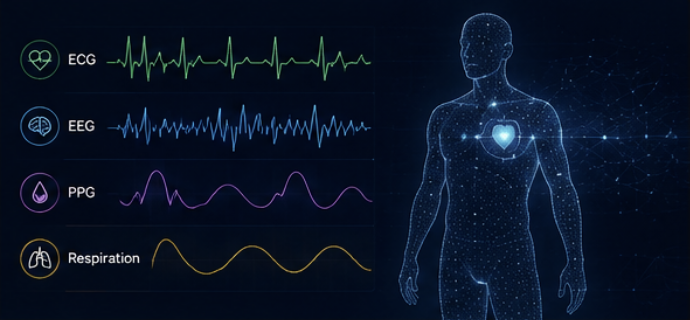
ECG, EEG, PPG and respiration waveforms alongside a digital human body model

Section 1

Every great medical device starts with an idea

Innovation in healthcare rarely begins with technology. It begins with an observation: a patient group that is discharged without follow-up, a therapy whose effect nobody can measure objectively, a diagnostic step that depends on the availability of a specialist.

Someone inside the organisation recognises that a device could close that gap. The idea is usually clinically precise long before it is technically defined — and that is the right order.

  • Continuous patient monitoring
  • Digital biomarkers
  • Smart rehabilitation
  • AI-assisted diagnostics
  • Wearable medical devices

Starting point

Clinical Need

Becomes

Innovation Idea
Section 2

What does it actually take to build an AI medical device?

Between an idea and a validated prototype sits a chain of disciplines. Each step depends on the previous one, and a weakness anywhere in the chain limits everything downstream.

  1. 01

    Clinical Problem

    Define the clinical need, the user and the measurable outcome the device must deliver.

  2. 02

    Sensor Selection

    Choose modalities and hardware that can actually capture the physiological signal of interest.

  3. 03

    Electronics Concept

    Signal chain, power budget, form factor and data acquisition architecture.

  4. 04

    Embedded Software

    Firmware, sampling, synchronisation and reliable on-device data handling.

  5. 05

    Biomedical Signal Processing

    Denoising, artefact handling and quality assessment that make raw data analysable.

  6. 06

    Artificial Intelligence

    Model development for detection, classification and prediction on real recordings.

  7. 07

    Prototype Development

    An integrated demonstrator that runs end to end in a realistic setting.

  8. 08

    Validation

    Benchmarking against clinical references, evaluation criteria and robustness tests.

  9. 09

    Technology Transfer

    Documented methods, models and know-how handed over for industrial development.

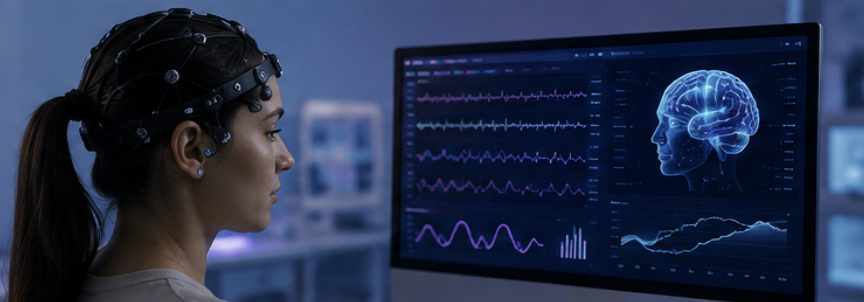
Researcher wearing an EEG cap while physiological signals are analysed on a multi-channel workstation
Multidisciplinary work in practice: sensing, acquisition, signal processing and model development evaluated in one loop.

Section 3

Many companies think they need an engineering department

Faced with that chain of disciplines, the instinctive response is to hire. Before a single hypothesis has been tested, organisations start planning a permanent team:

  • Electronics engineers
  • Embedded developers
  • AI researchers
  • Biomedical signal processing specialists
  • Data scientists

The myth

“We cannot start until we have the team.”

Recruiting an interdisciplinary engineering organisation takes years and fixes cost long before feasibility is known. It also front-loads the wrong risk: the open question at this stage is not capacity, it is whether the concept works at all.

Section 4

Validate first. Scale later.

The modern development model separates the research phase from the product phase. In the research phase the goal is evidence: does the sensing concept capture the signal, can AI extract the clinically relevant information, and does the whole chain hold up on real data?

DFKI supports companies during exactly this phase — helping design, prototype and technically validate new AI-enabled medical technologies with a team assembled around the specific question.

  • Concept development
  • Sensor selection
  • Electronics concept
  • Embedded AI
  • Biomedical signal processing
  • AI model development
  • Medical sensor fusion
  • Prototype development
  • Technical validation

Where the boundary sits

DFKI focuses on research, feasibility studies and prototype development. Commercial product engineering, certification and large-scale manufacturing are typically carried out afterwards by industrial partners.

Section 5

Example development journey

A typical path from an internal observation to a commercial product, and who owns which stage.

  1. 1

    Healthcare Company

    Company

    An organisation with market access and a product ambition.

  2. 2

    Clinical Challenge

    Company

    A defined unmet need with measurable success criteria.

  3. 3

    Research Collaboration with DFKI

    DFKI

    Multidisciplinary team assembled around the specific question.

  4. 4

    Prototype

    DFKI

    Sensors, embedded stack, signal processing and AI integrated end to end.

  5. 5

    Validation

    DFKI

    Technical feasibility evidenced on real data and realistic conditions.

  6. 6

    Technology Transfer

    DFKI → Company

    Methods, models and documentation handed over to the partner.

  7. 7

    Industrial Product Development

    Industry

    Product engineering, regulatory work and certification.

  8. 8

    Commercial Product

    Industry

    Manufacturing, market launch and scale.

Section 6

Why this approach reduces risk

Reduce development risk

Answer the hard technical questions before committing capital to a product programme.

Validate technical feasibility early

Evidence on your own data, in your own context — not a slide-deck assumption.

Avoid building unnecessary internal teams

Access specialists for the phase where they matter, instead of hiring for a permanent department.

Accelerate innovation

Electronics, embedded systems, signal processing and AI expertise working in one coordinated team.

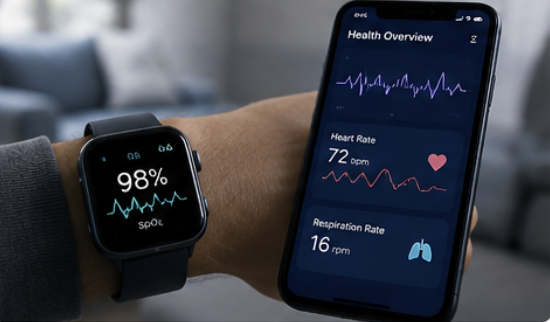
Smartwatch showing an SpO₂ waveform next to a mobile health app with heart and respiration rate signals
A validated prototype answers the question that matters before product engineering starts: does the concept produce reliable, clinically meaningful output outside the lab?

Section 7

Who benefits most?

Medical Device Companies

Extend existing devices with AI or explore an entirely new sensing concept.

Pharmaceutical Companies

Digital biomarkers and objective endpoints for trials and therapy monitoring.

Digital Health Companies

Turn app and platform data into validated, clinically meaningful signals.

Healthcare Technology Companies

Add embedded intelligence to hardware and monitoring infrastructure.

Hospitals

Translate clinical observations into technically feasible innovation projects.

Research Organisations

Complement clinical or scientific work with applied AI and engineering capacity.

Have an Idea for a New AI-Powered Medical Device?

Whether you are exploring wearable medical devices, physiological monitoring, smart rehabilitation or digital health technologies, DFKI can help validate your idea before large-scale product development begins.